
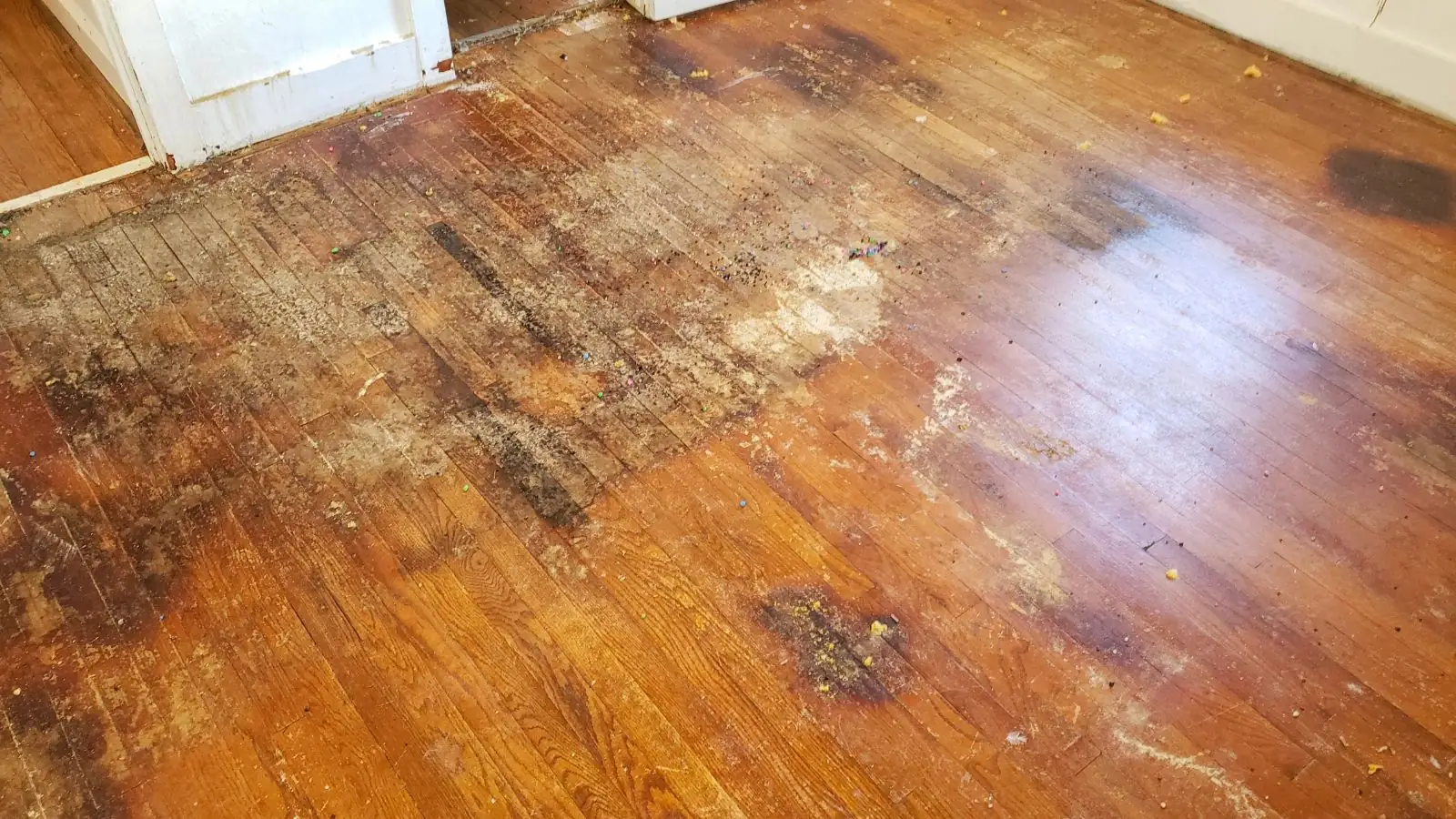
Wood and water do not mix, and a wet hardwood floor changes shape in ways you can see in a few days. Boards swell, edges lift, the middle drops, and a floor that was flat becomes a ripple. If your hardwood or laminate floor has been soaked in Deerfield, IL, the clock is running, so call for hardwood floor water damage repair on our 24/7 line before the boards finish moving.
What water does to a wood floor
- Cupping: the edges of each board rise higher than the center, because the bottom of the board absorbed more moisture than the top.
- Crowning: the center rises. This often shows up after a cupped floor is sanded before it has dried fully.
- Buckling: boards lift off the subfloor, which is serious and often needs removal.
- Staining: gray or black marks appear where water sat, and can mean mold or tannin reactions.
- Gapping: boards shrink as they dry too fast and leave spaces.
Common causes we see
A washer supply valve that fails while no one is home, an HVAC condensation line that backs up into a hardwood room, a dishwasher leak that creeps under the floor, and a supply line break all end the same way.
The water gets under the boards and sits between the flooring and the subfloor, where air cannot reach it. A floor can look nearly normal for a day or two and then cup noticeably.
Walnut, oak, maple, and engineered boards all react differently, and engineered floors with a thin top layer can delaminate. Laminate floors made from fiberboard swell at the seams and often cannot be saved.
What we do first
- Find the source and stop itWhatever caused the water must be fixed or shut off.
- Extract surface waterSee water extraction for how water is removed.
- Test the floorMoisture meters on the boards and subfloor show how far the water went.
- Choose a drying methodFloors can be dried with air movers and a dehumidifier, with drying mats pulling moisture through the boards, or with boards removed to open the area.
- Monitor and waitWood dries slowly. Readings decide when it is done.
Do not sand too soon
It is tempting to sand and refinish a cupped floor right away. If the boards are still wet, sanding flattens them while wet, and as they continue to dry, they crown and gap. A floor needs time at a stable dry moisture level before refinishing. This is the most common mistake people make with wet hardwood, and it is why the drying plan comes first.
Save, repair, or replace
| Condition | Typical path | |
|---|---|---|
| --- | --- | |
| Light cupping caught early | Dry thoroughly, wait, then evaluate for refinishing | |
| Cupping with wet subfloor | Dry subfloor and boards, may need partial board replacement | |
| Buckled boards | Remove affected boards, dry the subfloor, replace | |
| Black stains or mold | Remove affected boards, treat, see [[mold-remediation | mold remediation]] |
| Laminate or thin engineered flooring | Often replaced because swelling does not reverse |
Floors over a basement or crawl space
Water in the basement or crawl space below often reaches the underside of the subfloor, which then wicks into the boards. The basement water damage page and crawl space page describe what is done underneath. A wet floor with no obvious source often means the water is below.
Scope, price, and insurance
Scope and price are explained before work starts, and they depend on:
- Flooring type. Solid hardwood, engineered wood, and laminate behave differently.
- Area wet. A single room is different from several rooms of continuous flooring.
- Duration. Boards wet for days are less likely to be saved.
- Subfloor condition. Wet subfloor adds drying time and possible replacement.
- Finish work. Sanding and refinishing are a separate phase after drying.
Insurers often distinguish sudden damage from slow leaks, and flooring claims often hinge on documentation. Photograph the floor, take moisture readings if you can, and ask your insurer how your policy treats the source.
Safety and standards
Wet floors are slick, so mark the area and keep foot traffic off. Do not sand or seal wet boards. Moisture targets and drying methods follow the principles of ANSI/IICRC S500.
Hardwood wet and starting to cup? Call now so drying can start while boards can still be saved.
☎ (833) 521-1033Service area
We serve Deerfield and nearby towns, including Lake Forest, Highwood, and Lincolnshire.
A fresh soaking is urgent because boards can begin to move within days. Our line is open 24/7. Older stains are less urgent but still worth a moisture check.
Often, if the water was clean and drying began quickly. Floors that sat in wet conditions for days are less likely to be saved.
Sometimes. A cupped floor can relax as it dries, but not always. Wait until moisture readings are stable before deciding.
Frequently asked questions
Is this an emergency?
Can hardwood floors be saved after water damage?
Will the floor go back to flat?
What about a washer valve that broke while I was away?
The water likely ran for hours, which means the subfloor is probably wet too. Call as soon as you find it.
Wet hardwood floor in Deerfield? Call (833) 521-1033, answered 24/7.
☎ (833) 521-1033